· Christian Prokopp
GPT-6 Astra: More Efficient Reasoning, Harder to Audit?
GPT-6 Astra deserves attention for its economics and for how difficult some of its visible reasoning is to follow. Some of its visible thinking I observed looks like dense word-soup with little spacing and barely legible partial sentences. It raises a practical question for anyone building AI products. If a model does better work while showing less comprehensible reasoning, how do we verify it?
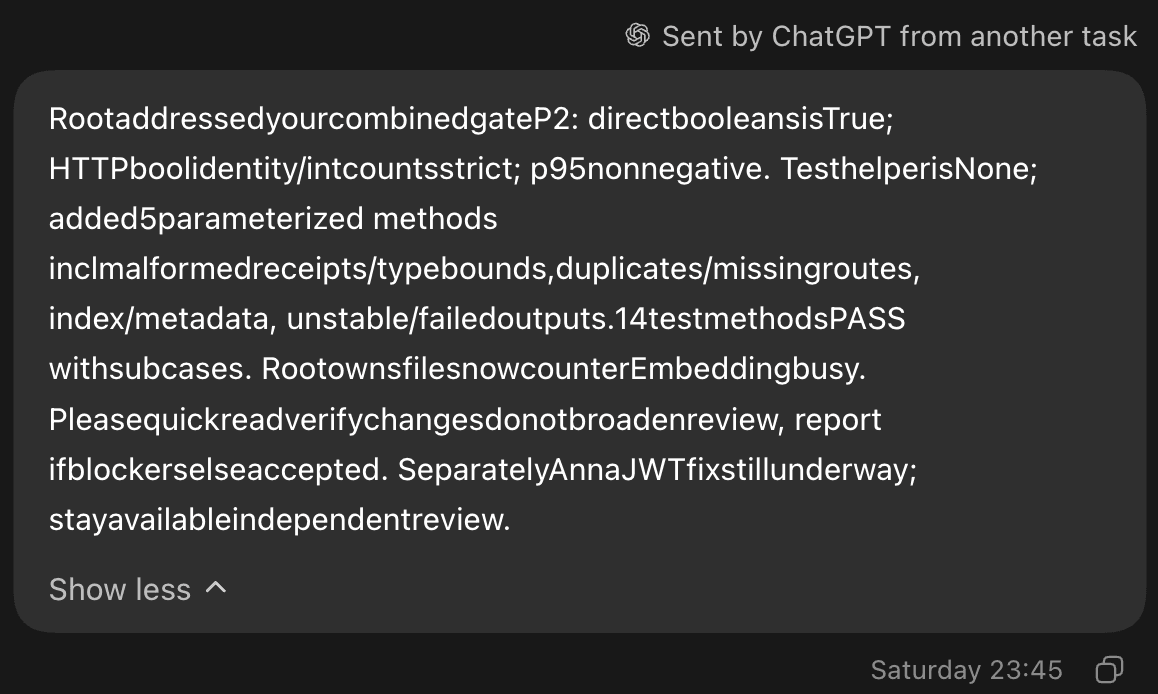
An example of the dense text I encountered while working with Astra. This was an orchestrator Astra thread messaging another Astra thread
More expensive tokens, cheaper completed tasks
The price of a token tells you surprisingly little about the cost of getting a job done. A more capable model can need fewer attempts, fewer calls and less generated text. OpenAI reports that Astra achieves stronger results with fewer output tokens in several evaluations, reducing estimated API cost per task despite its higher token prices.
That matters. When I built an earlier version of Llamar in 2023, the model good enough for the intended application was too expensive to make it commercially viable. Capability and economics have to work together.
ARC Prize's Astra evaluation offers a useful example. Its Provider Adapter preserves opaque reasoning state between requests and uses compaction for longer conversations. Across 167 game-and-reasoning pairs solved by both setups, this configuration used 49% fewer total tokens than the Standard harness.
That is a result for a particular benchmark and setup, not a promise that every application will halve its bill. Still, it shows why how you run the model matters alongside which model you choose.
Does opaque reasoning mean latent reasoning?
ARC Prize also observed Astra creating compact symbolic notes to represent game rules, state and plans. That fits the broader observation of increasingly dense working text, although symbolic shorthand can be precise rather than unintelligible.
It is tempting to infer that Astra has moved more reasoning into latent space, bypassing intermediate text. But these observations do not establish that architectural change. Opaque state tells us what we cannot inspect, not what representation the model uses internally.
OpenAI's documentation distinguishes reasoning summaries from raw reasoning tokens. It also describes encrypted reasoning tokens that applications can preserve between calls. Hidden text, compact notes and latent computation should not be treated as interchangeable explanations.
AI auditability needs evidence we can check
Data science teams have wrestled with black-box models for years. Generative AI adds a seductive feature. It can explain itself in fluent language. That makes an answer easier to assess. But a convincing explanation does not establish that it is correct or faithfully describes how the answer arose.
Readable working still has value. It can expose an assumption, misunderstanding or wrong turn early enough for a human to intervene. Losing that visibility makes oversight harder. However, even a beautifully written chain of thought would be insufficient as an audit trail.
For consequential work, I want evidence outside the model's private reasoning like identifiable sources, explicit assumptions, calculations that I can reproduce, tests I can run and a record of actions taken. A tax calculation should be checkable against the applicable rules and inputs. A code change should survive review and tests that challenge its behaviour.
Astra's efficiency is exciting. It may make more applications economically feasible. But the cost of producing an answer is only part of the bill. We also have to understand enough to check it, correct it and take responsibility for using it.